

Vakarei
SL/E/KAYA/M/11
SS British Sergeant · British Sergeant
- Period
- 2 nd World War, Colonial - British
- Year sunk
- 1942
- District
- Batticaloa
- Depth
- 13.00–25.00 m
- Vessel type
- Iron Hull, Steam Ship, Tanker, Bulk Carrier
Overview
This shipwreck is positioned at a maximum depth of 25m, about 6km off the coast of Kayankerni, an area which is about 35km north from Batticaloa towards Trincomalee. Constructed by Palmer's Shipbuilding and Iron Company Ltd., in Newcastle-upon-Tyne (England), SS British Sergeant was operated by British Tanker Company, starting from 27th February 1922. This iron vessel weighed 5,868t and was 122.1m (400ft 7in) in length and 16.5m (54ft 2in) in breadth. The hull depth of the ship was 10m (32ft 10in). Powered by two turbines with a single propeller, this steam vessel could reach a maximum speed of 10knots (nautical miles per hour).
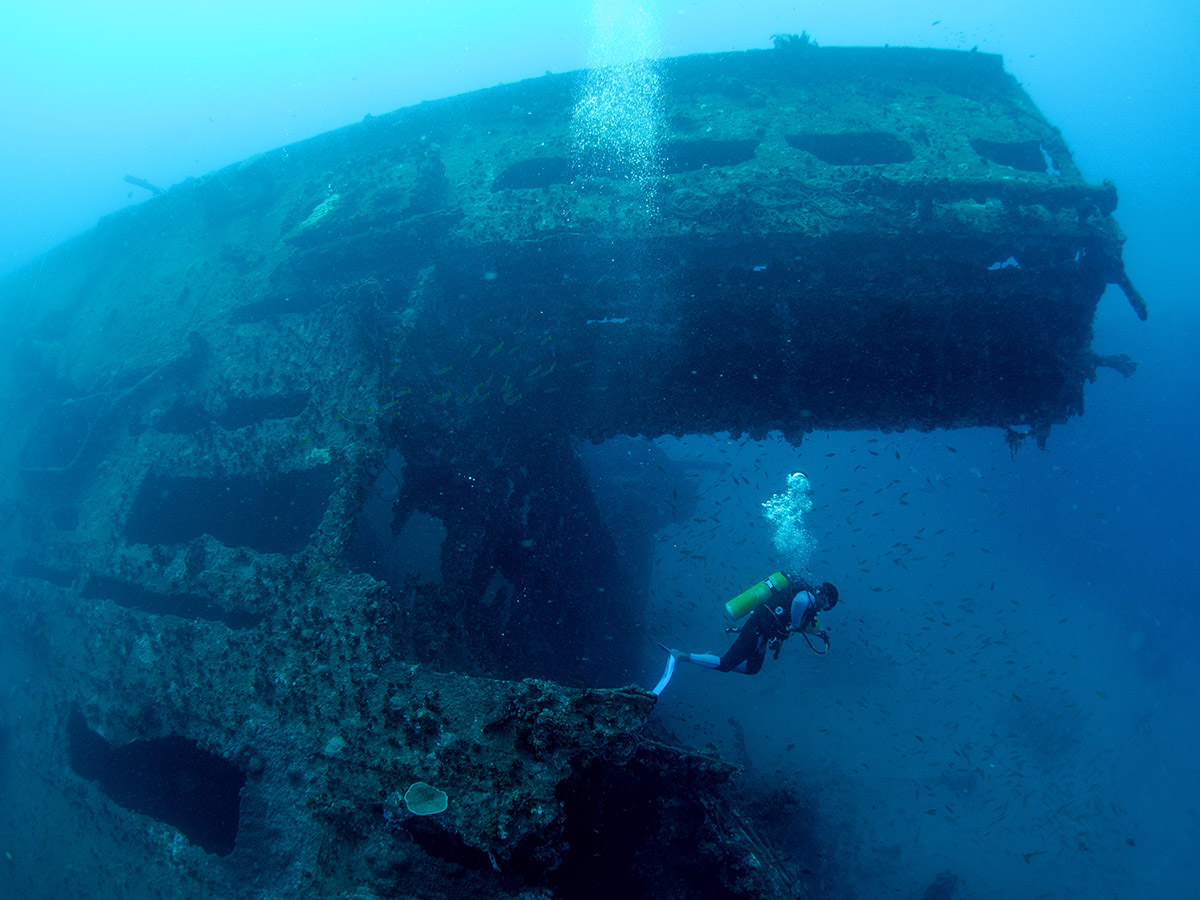
SS British Sergeant was sunk on the 9th of April 1942, upon the bombardment of the Japanese air force during the World War II. Although no casualties were recorded, the ship was broken into two distinct pieces close to the mid of the vessel. The bow section lies upside down (with the keel up) on the sandy seabed while the stern (rear section) lies about 15m away from the bow, tilted to the starboard side. The large cavern in the hull of the bow section provides an opportunity to explore the inside safely. However, the propeller cannot be observed at the stern section seemingly buried under the sand.
SS British Sergeant is one of the seven World War II shipwrecks in Sri Lanka that are divable, the others being HMS Hermes, SS Sagaing, HMS Hollyhock, SS Athelstane, HMAS Vamfire and SS Norviken. In addition to the multiple heritage values, the wreckage is home to a large aggregation of fish species, enhancing the wreck’s value as a resource of biodiversity. Accordingly, Blue-Striped Snappers can be observed, especially at the aft section, and several other species of schooling fish (i.e. Sri Lankan Rabbitfish, Blue Striped Snappers, Bluefin Trevally) seek shelter within the caverns of the ship. As such, the wreck site has become a target of the dynamite fishermen in the area and thus requires urgent protection.
Other Information:
Launched: 27 February 1922 Completed: August 1922
Type: Oil tanker Tonnage: 5,868 GT
Length: 122.1 m (400 ft 7 in) Beam: 16.5 m (54 ft 2 in) Depth: 10 m (32 ft 10 in)
Propulsion: 2 Steam turbines, single shaft, 1 screw Speed: 10 knots (19 km/h; 12 mph)
Fate: Sunk on 9 April 1942
Media gallery
·
Location
Exact location withheld to protect this protected site.
For heritage protection, precise coordinates are not published for this site. Only the general administrative area is shown.
Batticaloa, Eastern
Protection & status
- Access
- None
- Legal status
- Protected by Arch Act
- Archaeological value
- High
- Physical protection
- None
- Degradation
- Corrosion
- Owner site
- DoA
- Authority
- MAU-CCF & DoA
- Threat
- Looting
Vessel chronology
1942
Year sunk
1922 – 1942
Time period estimate
References & publications
- Jayawadena, D. (2016) Ghosts of the Deep - Diving the shipwrecks of Sri Lanka, Vijitha Yapa Publications, Colombo, pp.188-197.
- https://en.wikipedia.org/wiki/SS_British_Sergeant - 2019.05.22
Related shipwrecks
.jpg)
15 Km west Of Colombo
SL/W/COLO/M/07
- Period
- 1 st World War
- District
- Colombo
- Depth
- 50–60 m
.jpg)
17 Km west of Colombo
SL/W/COLO/M/15
- Period
- 1 st World War
- District
- Colombo
- Depth
- 35–40 m
.JPG)
06 km West of Negombo
SL/W/NEGO/M/25
- Period
- Colonial - British
- District
- Gampaha
- Depth
- 8–11 m
.JPG)
NSD-0039
SL/E/IRAK/M/01
- Period
- Colonial - British
- District
- Trincomalee
- Depth
- 6–9 m