

Galle
VOC Hercules GHF
SL/S/GHRB/M/13
- Period
- Colonial - Dutch
- Year sunk
- 1661
- District
- Galle
- Depth
- 2.00–10.00 m
- Vessel type
- Wooden Sail, Bulk Carrier
Overview
The Hercules was built in Zaandam in 1655, a yacht purpose-built to ply regional routes within Asia. She sailed for Asia in the same year and remained in the region until she came to grief six years later.
In the early morning of 22 May 1661, a small fleet of four ships was ready to sail to Batavia. Two officers were persuaded by the fine weather to take the ships out of the harbour before any adverse change. There are several reefs in the area which lie hidden just below the surface, inviting disaster for ships entering or leaving the harbour without a pilot at the helm. After the flute Elburg and the yacht Tholen were guided out of the bay, the pilot returned and prepared to take the yachts Hercules and Angelier out of the bay together. An eyewitness aboard the Angelier gave an account of what went wrong after the ships weighed anchor:
'When the crew of the Angelier had weighed anchor and were busy pulling up the sails, quite suddenly a strong cross-wind struck the ship. We managed to fasten the sails again and to throw the anchor. On the Hercules however, half a pistol shot from us, things went wrong. I saw that the anchor rope was broken. This seemed strange to me since this rope wasn’t bad and no other ship in the bay at that moment had the same problem. Still, they tried to throw the second anchor, but in this case, the end of the rope wasn’t secured to the mast so they lost the second anchor too. Without anchors, the ship was now a playing ball of the elements. The bow of the ship turned in the direction of the land and was breaking to pieces on the cliffs a few moments later.'
The site of the Hercules is in shallow water, just south of the rock seawall of Gibbet Island. Before this wall was built, there was a small bay between Gibbet and Closenberg Islands, and the Hercules lay just west of the entrance to this bay.
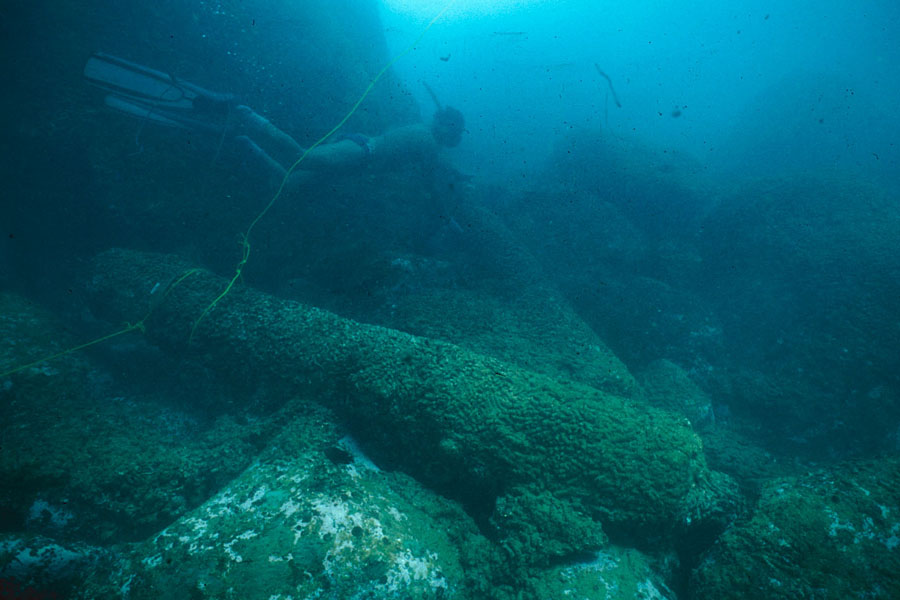
Scattered among large boulders are more than thirty iron cannon. Other finds have included iron shot, sounding leads, Dutch bricks, and the ship's bell. The site is exposed to heavy swells, particularly during the southwest monsoon, and it is not yet clear how much other material may survive under the seabed.
The site was preliminarily surveyed by the Galle Harbour Project in 1992-93. Immediately offshore are large boulders, which give way to a sandy seabed. The limited excavation was carried out at this sand-rock interface, in an attempt to determine whether archaeological material survived under the sand. The use of a water dredge around the group of three cannon closest to the interface revealed a number of concreted iron shot (round and bar), and a number of unidentified concretions. However, excavation in the sand area to a depth of about half a metre revealed only sterile and uniform sand-shell material. Further investigation of this site would be worthwhile.
The bell is of bronze, and inscribed 'AMOR VINCIT OMNIA ANNO 1625' (love conquers all, the year 1625).
Most of the cannon are encrusted with concretion and marine growth. Among the more open spread of boulders towards the western end of the site, three cannon have been severely eroded, and in one example the bore passage has been exposed. Most of the cannons are about 3 metres long, in their concreted state. One smaller cannon has been noted, about 2 metres in length, part of a mid-site cannon cluster.
Media gallery
·
Location
Exact location withheld to protect this protected site.
For heritage protection, precise coordinates are not published for this site. Only the general administrative area is shown.
Galle, Southern
Protection & status
- Access
- Yes
- Legal status
- Protected by Arch Act
- Archaeological value
- Very High
- Physical protection
- None
- Degradation
- Corrosion
- Owner terrain
- Dept of Archaeology
- Owner site
- Department of Archaeology
- Authority
- DOA & MAU-CCF
- Threat
- Corrosion
Vessel chronology
1661
Year sunk
References & publications
- Maritime Archaeology in Sri Lanka: Twenty five years old and a new beginning, in SHIPWRECK AROUND THE WORLD : Revelations of the Past (2015)
Related shipwrecks
NSD-0040
HMS Diomede
Diomede wreck
SL/E/UPPU/M/02
- Period
- Colonial - Dutch
- District
- Trincomalee
- Depth
- 41–43 m
Hambantota
Silver Coin Wreck
SL/S/GBAS/M/04
- Period
- Colonial - Dutch
- District
- Hambantota
- Depth
- 8–12 m
Habaraduwa
Lord Nelson
SL/S/UNAW/M/08
- Period
- Modern
- District
- Galle
- Depth
- 3–6 m
.jpg)
Galle
Extraco - I
Cement wreck or Site "O" in Galle Harbour
SL/S/GHRB/M/09
- Period
- Modern
- District
- Galle
- Depth
- 7–14 m