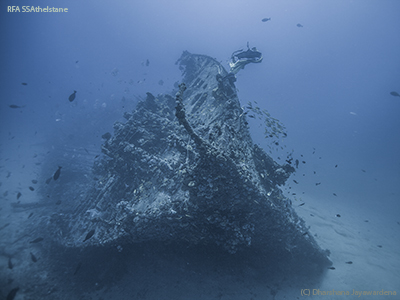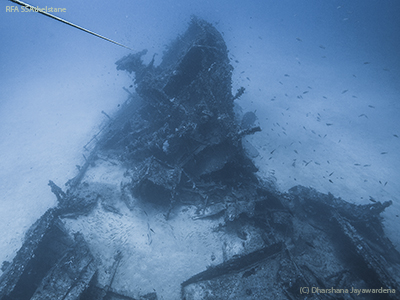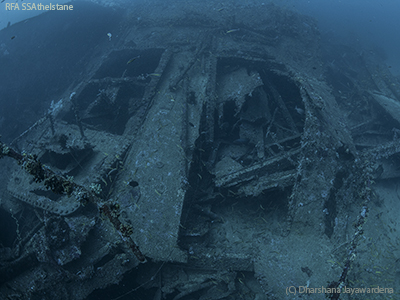
Royal Fleet Auxillery (RFA) tanker SS Athelstane, built by Irvine’s Shipbuilding & Drydock Co. Ltd, was sunk off the coast of Oluvil on 9th of April 1942, during the second Japanese attack of Ceylon during World War 2. It sank without casualties and rests on seabed 35m (bow) - 42m (stern) deep.
This shipwreck is positioned at a maximum depth of 42m, about 15km off the coast of Oluvil, an area which is about 60km southeast of Batticaloa. Constructed by Irvine’s Shipbuilding & Dry dock Co. Ltd. in Hartlepool (England) and owned by the British Royal Navy, SS Athelstane was one of the largest support ships of the British Royal Navy, hence named ‘Royal Fleet Auxiliary (RFA) tanker SS Athelstane’. This iron vessel weighed 5,570t and was 122m (400ft 2in) in length and 16m (52ft 4in) in breadth. Powered by a steam engine with a single propeller, this steam ship was equipped with numerous armaments mounted onboard and was employed in service to distribute essential oils to other British Royal Navy fleets in the country.
SS Athelstane was sunk on the 9th of April 1942, upon the bombardment of the Japanese air force during the World War II. Although no casualties were recorded, the ship was severely destructed due to the explosions caused by burning the supplementary oil storage tanks. HMS Hollyhock was also sunk at the same time, just about one kilometer away from the SS Athelstane. This large wreck is the only wreck, other than the HMS Hermes, to have armament visible, which is in the form of a rear-facing stern-mounted defensive gun. The stern (rear) section is almost severed from the rest of the wreck, which lies listing to starboard. Other key features are the holding tanks, the engine, the bridge and the bow with a davit, the latter being a feature recognizable in old photos of the SS Athelstane.
SS Athelstane is one of the seven World War II shipwrecks in Sri Lanka that are divable, the others being SS British Sergent, SS Sagaing, HMS Hermes, HMS Hollyhock, HMAS Vamfire and SS Norviken.
The bow of the Athelstane showing the forward david, a recognisable feature from old pictures of the ship
No artifacts recorded for this shipwreck.