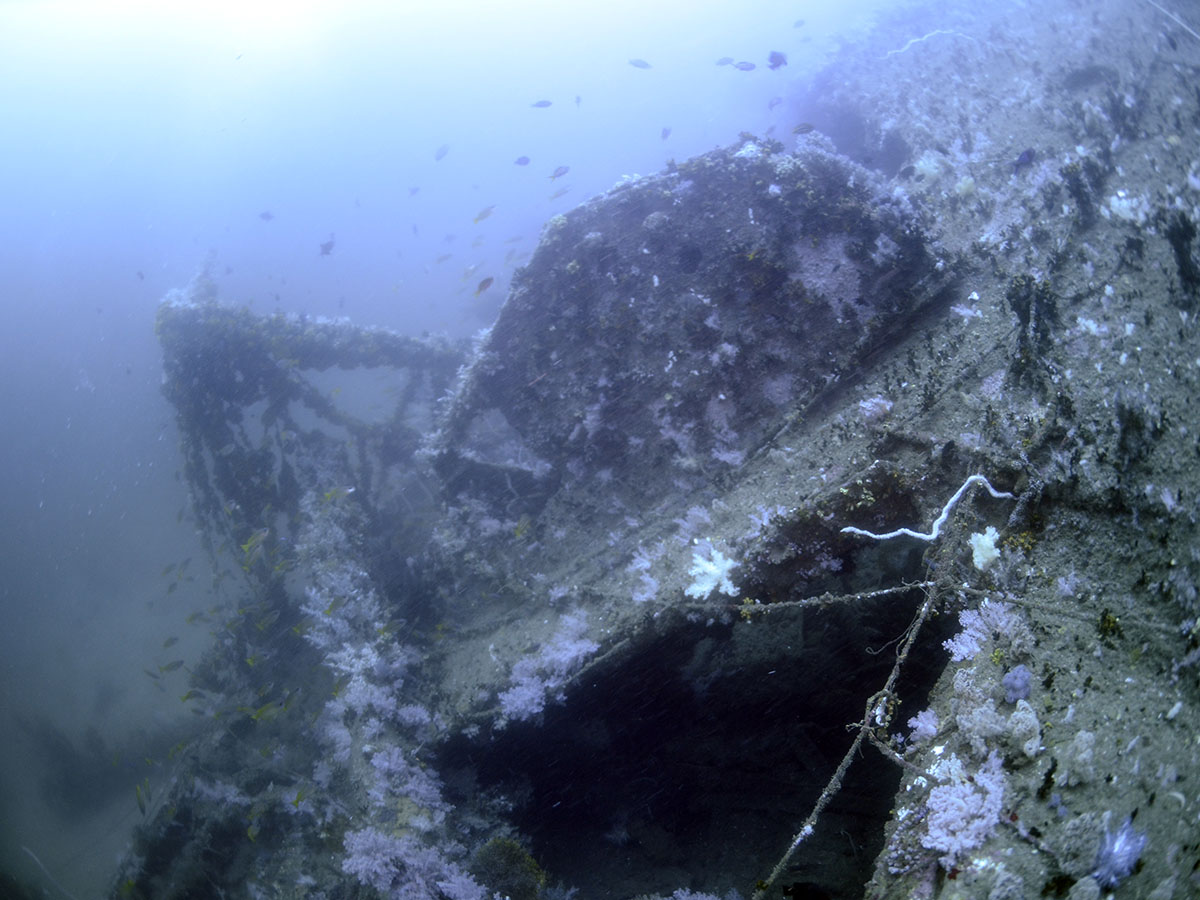
This shipwreck is positioned at a maximum depth of 53m, about 8km off the coast of Batticaloa. Constructed by Sir W.G. Armstrong Whitworth & Co. Ltd. in Newcastle upon Tyne (England), HMS Hermes was the world's first purpose-designed aircraft carrier, launched on the 11th September 1919 and commissioned on the 18th February 1924. The displacement tonnage of this iron vessel was 11,020t in standard and 13,900t with a deep load. HMS Hermes was 182.9m (600ft) in length and 21.4m (70ft 3in) in breadth. The draught of the ship was 7.1m (23ft 3in) with a deep load. Powered by six water-tube boilers of 40,000-horsepower (30,000kW) and two geared steam turbine sets with two propellers, this vessel could reach a maximum speed of 25knots (nautical miles per hour). HMS Hermes could accommodate up to 566 crew (excluding aircrew) and carried 20 aircraft on board. Further, the ship was equipped with numerous armaments including three 102mm anti-aircraft guns. The vessel was involved in a number of operations and joined the service of the Indian Ocean in 1942.
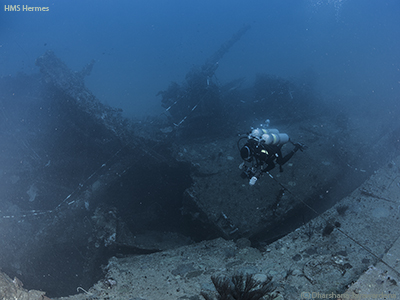
Upon the intel received of a Japanese attack during the World War II, HMS Hermes, which was docked at the Colombo port, was sent to the Trincomalee harbour for safety and could survive the first Japanese attack on the 5th April 1942. Subsequently, by learning of a second attack, the vessel set sail for the Maldives on 8th April 1942. However, Japanese fighter jets did not allow the ship to travel long and launched a massive attack on the 9th of April 1942 near Batticaloa, causing 307 casualties (out of 814 crew) and making the ship sunk 10 minutes after the bombing raid. Presently, the shipwreck lies upside down (keel up position) on the seabed and the bow (front) section is broken up and collapsed. One of the two propellers can be clearly seen, while the other is partially buried in the sand. The large anchors, the island superstructure and several of the below deck and on-deck anti-aircraft guns can still be observed.
HMS Hermes is currently rated as one of the top 100 SCUBA dives in the world and as the most famous wreck dive in Sri Lanka. In addition, it is one of the three divable aircraft carriers in the world and the only aircraft carrier that sank in a battle. Moreover, it is one of the seven World War II shipwrecks in Sri Lanka that are divable, the others being SS British Sergent, SS Sagaing, HMS Hollyhock, SS Athelstane, HMAS Vamfire and SS Norviken. Apart from the multiple heritage values, the wreckage is noteworthy because of the large aggregation of marine life in and around it, which enhances the wreck’s value as a resource of biodiversity. Accordingly, large shoals of Barracuda, Grey Snappers, Blue-Striped Snappers, Trevally and Dog-Tooth Tuna can be observed, while a large out coup of Black Coral can be found on the wreck, especially on the bow section.
As of June 2021, this is the second-largest shipwreck in Sri Lanka after the ‘X-Press Pearl’ wreck. ‘Admiralty Floating Dock 23’ is not considered the largest as it was partially salvaged in the late 1960s/early 1970s. Hence, if X-Press Pearl is salvaged, HMS Hermes will regain its status as the largest shipwreck in Sri Lanka.
Other information:
Designated War Grave
Displacement: 10,850 long tons (11,020 t) standard , 13,700 long tons (13,900 t) (deep load)
Length: 600 ft (182.9 m) Beam: 70 ft 3 in (21.4 m) Draught: 23 ft 3 in (7.1 m) (deep load)
Installed power: 6 water-tube boilers 40,000 shp (30,000 kW) , Propulsion: 2 shafts; 2 geared steam turbine sets , Speed: 25 knots (46 km/h; 29 mph)
Armament: 6 × single 5.5 in (140 mm) guns , 3 × single 4 in (102 mm) anti-aircraftguns , Armour: Belt: 3 in (76 mm) , Deck: 1 in (25 mm)
Complement: 566 (excluding aircrew) , Aircraft carried: 20
.jpg)